Active in Morocco & Perth · Pilot contracts open · EIC Accelerator €2.2M awarded
Brine Valorization

Chemical recovery from concentrated brine, where the chemistry supports it.

Hydrovolta evaluates and pilots chemical recovery from concentrated brine streams generated by SonixED™ desalination or existing desalination operations. The process configuration is determined by brine composition analysis. Target streams include acid, base, and selected mineral hydroxides. Active alongside SonixED™ desalination in the Morocco integrated deployment.

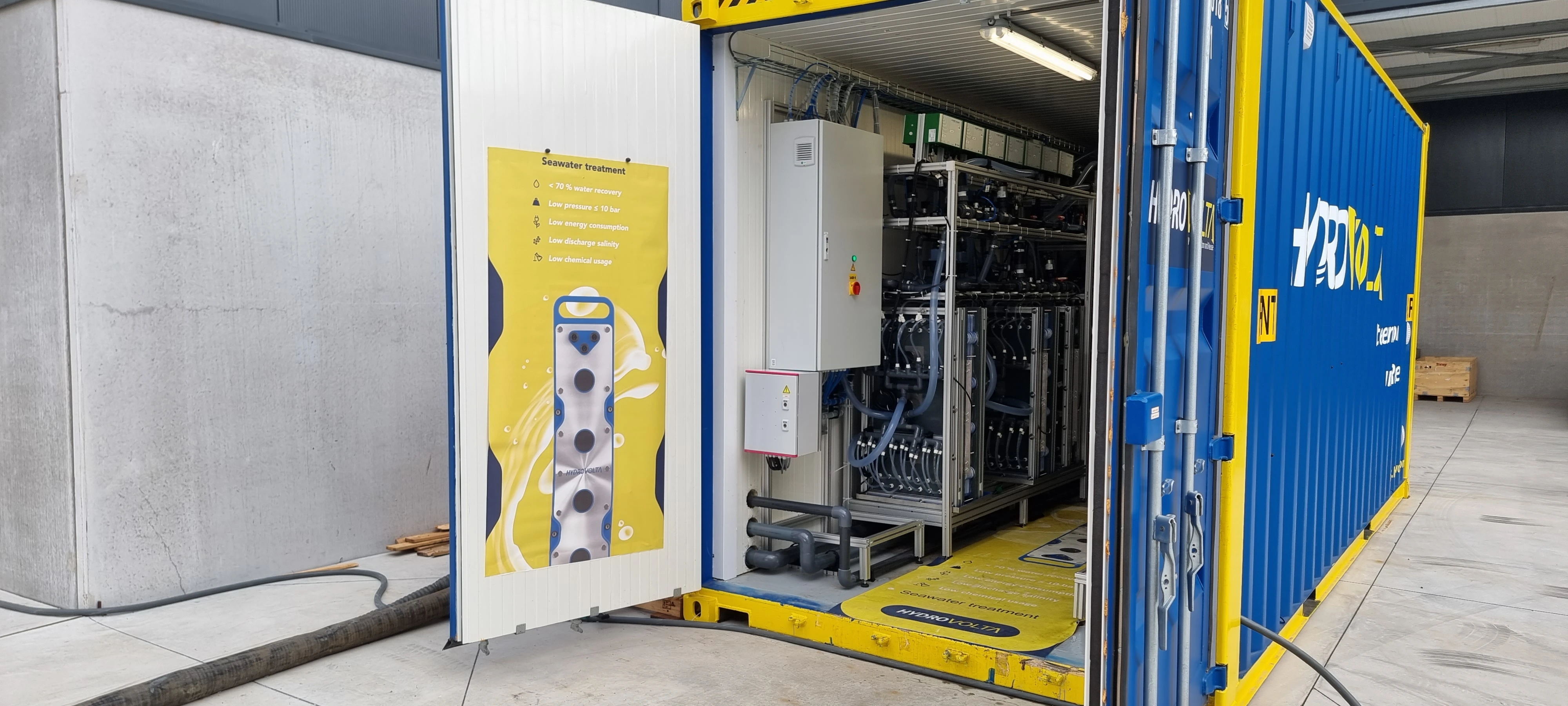
Brine valorization process equipment
The case for valorization

Brine is a cost item that can become a revenue stream.

Brine disposal is a significant operational liability for desalination operators — particularly in locations with restricted discharge permits, inland sites without coastal access, or industrial facilities under tightening environmental regulations. A valorization pathway converts the problem into a resource.

01

Disposal cost elimination

Brine that requires costly disposal, evaporation pond management, or deep well injection becomes a feedstock input for chemical production. Disposal liability is reduced or eliminated depending on brine volume and composition.

02

Chemical product revenue

HCl and NaOH are commodity industrial chemicals with established demand across manufacturing, water treatment, and processing industries. Mg(OH)₂ and Ca(OH)₂ serve construction, agriculture, and pharmaceutical markets.

03

Regulatory compliance support

Near-ZLD operation reduces liquid discharge volumes, supporting compliance with tightening industrial discharge permits and environmental reporting requirements in multiple geographies.

How valorization works

Brine composition determines the recovery pathway.

Hydrovolta’s brine valorization process uses electromembrane separation and complementary technologies to recover chemical streams from concentrated brine. The specific configuration is not fixed — it is engineered around the brine chemistry of each project. A brine rich in sodium chloride produces different recovery opportunities to a brine rich in magnesium or calcium salts. Feasibility is established through analysis first, then confirmed through a site-qualified pilot.

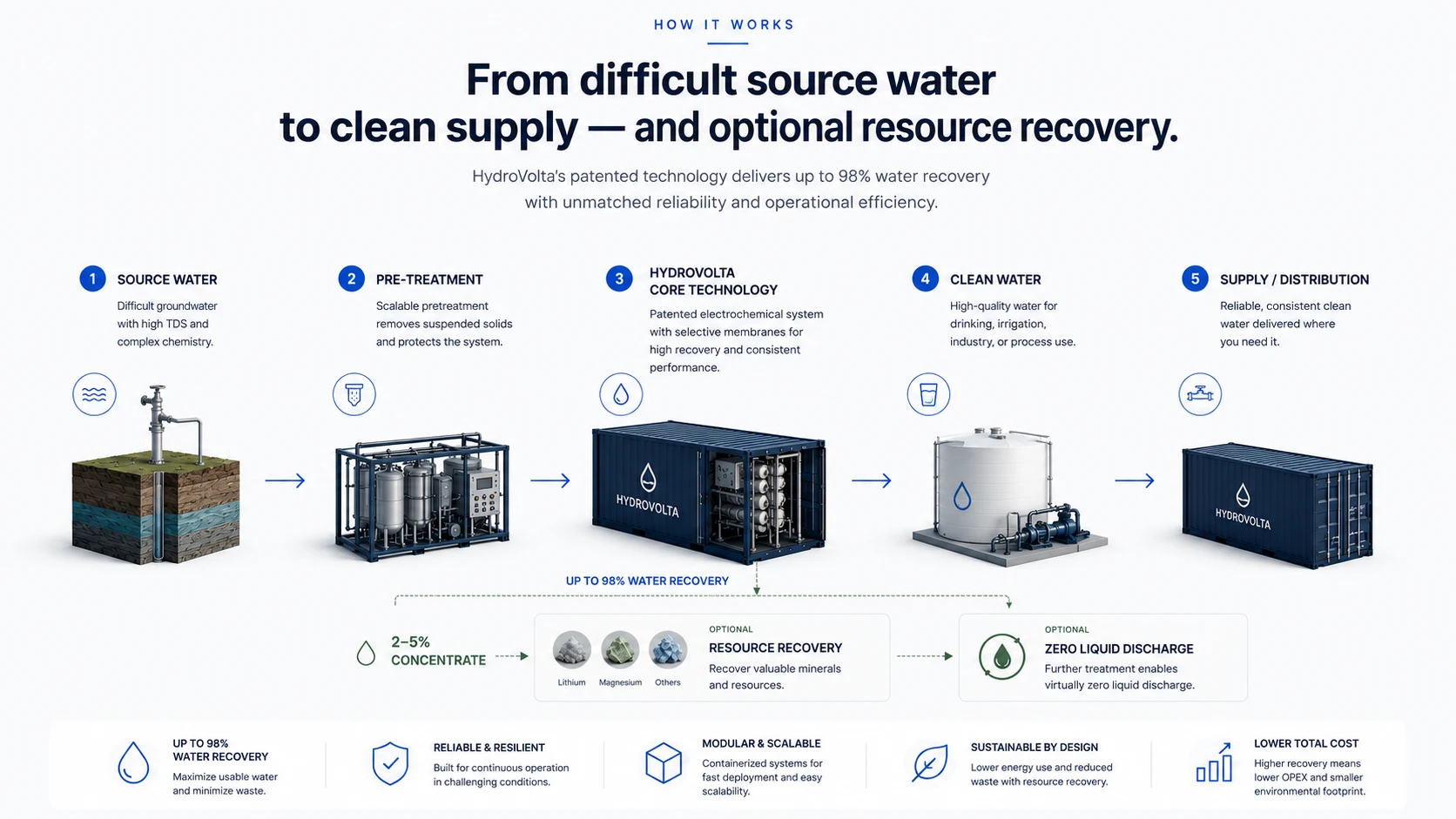
Detailed Hydrovolta process flow showing SonixED desalination feeding into brine concentrate, valorization and zero liquid discharge pathways

What determines feasibility

Hydrovolta assesses the following before recommending a valorization pathway:

  • Ion composition: Na¹, Cl¯, Mg²¹, Ca²¹, SO₄²¯ concentrations and ratios
  • Brine volume: flow rate determines whether a valorization configuration is economically warranted
  • Target products: commercial demand and site logistics for recovered streams
  • Site constraints: discharge regulations, available footprint, utility connections
  • Integration: whether brine comes from a SonixED™ project or an existing desalination plant

The process configuration — which may combine electromembrane separation, selective membranes, and other complementary technologies — is specified after analysis confirms feasibility. Hydrovolta does not apply a single fixed process architecture across all brine chemistries.

Potential recoverable product streams

Target products depend on brine composition and are confirmed through pilot assessment. Purity and yield are project-specific.

HCl

Hydrochloric acid. For chemical processing, metal treatment, and pH adjustment where NaCl-rich brine supports it.

NaOH

Sodium hydroxide. For chemical manufacturing and water treatment from sodium-rich brine streams.

Mg(OH)₂

Magnesium hydroxide. Recoverable from magnesium-rich brine for flame retardant and pharmaceutical applications.

Ca(OH)₂

Calcium hydroxide. Recoverable from calcium-rich brine for construction, agriculture, and water treatment.

Two deployment pathways

Valorization for new projects and for existing desalination operators.

Hydrovolta offers brine valorization through two distinct pathways depending on the client’s existing infrastructure and commercial objectives.

Pathway A

Integrated with SonixED™ groundwater projects

For Hydrovolta groundwater desalination deployments, the residual brine stream from SonixED™ (2–5% of feed volume, highly concentrated) can be routed directly into a downstream valorization configuration for chemical recovery. This is the model active in Morocco — a single integrated process delivering both clean water and industrial chemicals from the same source.

  • Residual brine characterisation included in project assessment
  • Valorization configuration sized to match SonixED™ brine output
  • Integrated operation managed through shared cloud telemetry
Pathway B

Standalone pilots for existing desalination operators

For operators of seawater RO plants or industrial desalination facilities that already generate concentrated brine, Hydrovolta can evaluate and pilot a standalone valorization configuration for selective chemical recovery. The brine analysis determines feasibility; the pilot generates the performance dataset for scale-up decisions.

  • Brine composition and flow analysis required before assessment
  • Pilot scope and configuration designed per site chemistry
  • HCl / NaOH recovery with potential for Mg(OH)₂ and Ca(OH)₂
Morocco reference

The integrated deployment model in practice.

The Morocco project is Hydrovolta’s primary reference for the integrated integrated desalination and brine valorization model. Seawater-intruded coastal aquifer groundwater at approximately 7,000 ppm TDS enters SonixED™ for high-recovery desalination. The concentrated residual brine is processed through the downstream valorization configuration for chemical recovery. Funded by the Flanders Climate Action Program. The project demonstrates that water desalination and chemical recovery from brine are not sequential concepts — they are a single integrated value chain.

Morocco integrated desalination and brine valorization deployment
Assessment criteria

What determines whether brine valorization makes sense.

Not every brine stream warrants a valorization pathway. Hydrovolta assesses four factors before recommending a pilot. Where all four align, the case is strong. Where they don’t, Hydrovolta says so.

01

Brine chemistry

Ion composition, concentration, contaminants, pH, and scaling potential. NaCl-rich, MgCl₂-rich, and CaCl₂-rich brines each support different product streams. Not all do.

02

Target outputs

HCl, NaOH, calcium hydroxide, magnesium hydroxide, or other selected fractions. The target products must have commercial demand and logistical viability at the site to justify the pilot.

03

Purity requirements

Downstream use determines whether recovered streams are technically meaningful. Industrial-grade HCl for a neighbouring process is different from pharmaceutical-grade. Feasibility depends on achievable purity given the brine.

04

Economics

Energy cost, capital for the valorization configuration, avoided disposal cost, logistics, and market value of recovered streams. The economic case must close before Hydrovolta recommends proceeding to pilot.
Engineering Assessment

Have a concentrated brine stream?

Send brine chemistry data including ion composition, TDS, volume, and site constraints. Hydrovolta will assess whether a brine valorization pilot pathway is technically and economically appropriate for your application.

Institutional partners & backing

European Innovation CouncilFlandersWater EuropeDe WatergroepFarysGSTICAquatech